

James webb Gallery
Truth Seekers

Webb’s First Deep Field
On this image, thousands of tiny galaxies may be seen. Their hues differ. While some are white, others are various colours of orange. While the majority look like fuzzy ovals, a few have unmistakable spiral arms. Several foreground stars can be seen in front of the galaxies. The bright stars contain diffraction spikes that give them an eight-pointed star shape and most have a blue appearance. The centre of the image is surrounded by numerous thin, long, orange arcs.
Carina NGC 3324
The image was taken by NASA's James webb Space Telescope and shows an undulating nebula, orangish cloudscape along the bottom and a comparatively clear upper portion. Speckled across both portions of the image is a starfield, showing innumerable stars of many sizes and hues. The largest of these appear larger, closer, brighter, and more fully resolved with 8-point diffraction spikes.

Stephan's Quintet
Office Manager
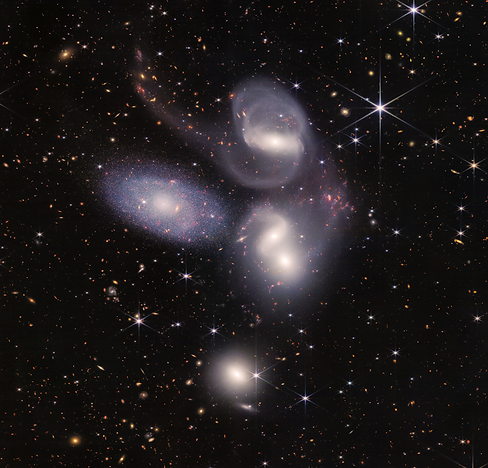
Five galaxies can be seen in the image, two in the middle, one at the top, one in the upper left, and one at the bottom. They are all visible in the sky together. Of the five, four seem to be in contact. One is a little apart. The image's galaxies are huge in comparison to the background's hundreds of much smaller (and farther away) galaxies. The centres of all five galaxies are brilliant white. Each one differs somewhat in terms of size, shape, composition, and colour. Many foreground stars with diffraction spikes, or bright white spots with eight bright lines radiating out from the centre of each, are scattered over the image in front of the galaxies.
Southern Ring Nebula
Southern Ring Nebula is a large, semi-transparent oval that is slightly angled from top left to bottom right. A bright white star appears at the center of this image. Alarge transparent teal oval surrounds the central star. Behind the gaseous teal layers are deeper orange layers that are arranged like threads in a complex weaving.


cartwheel galaxy
The galaxy formed as the result of a high-speed collision that occurred about 400 million years ago. The Cartwheel is composed of two rings, a bright inner ring and a colorful outer ring. Amidst the red swirls of dust, there are many individual blue dots, which represent individual stars or pockets of star formation.
Stay tuned...
More Images coming soon